
Custom Transfer Mold Manufacturer in China
Senses Mold designs and manufactures high-precision transfer molds for rubber, silicone, and thermoset materials. ISO 9001 & IATF 16949 certified — trusted by automotive, electronics, and medical buyers worldwide.
- 🎯 Tolerance: ±0.005 mm High Precision Machining Capability
- ⚡ Lead Time: 7–15 Days for Prototype Tooling / Fast Turnaround Supported
- 📜 Certification: ISO 9001 Certified Manufacturing System
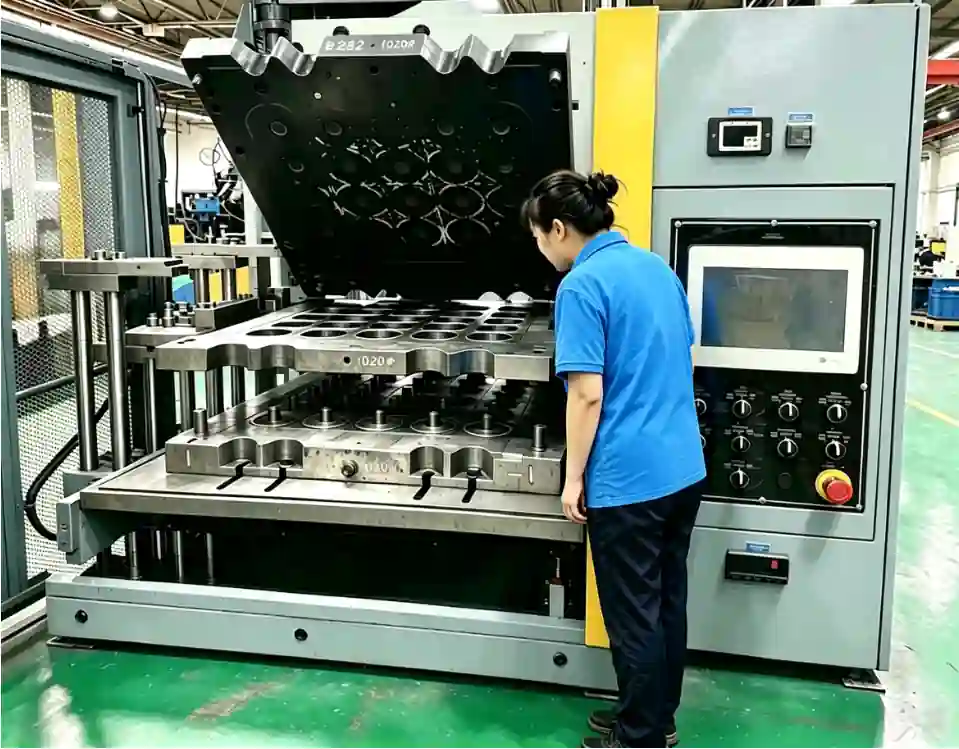
Transfer Molding Parts We produced


What is a Transfer Mold?
A transfer mold is a precision tooling system used to shape rubber, silicone, and thermoset materials into finished parts. Unlike compression molding, material is pre-loaded into a separate chamber called the pot, then forced through a runner system into closed cavities by a hydraulic plunger — delivering tighter dimensional control, cleaner flash lines, and consistent part quality across every shot.

Key Components of a Transfer Mold
🟧 ① Pot
Holds the uncured material (preform) before transfer begins
🟧 ② Plunger
Applies hydraulic pressure to push material through the runner system
🟧③ Runner & Gate
Channels that distribute material evenly into each cavity
🟧④ Cavity
The negative space that defines the final shape of the molded part
Key Components of a Transfer Mold
🟧 Step 1 – Load & Heat
A pre-measured rubber or thermoset preform is placed into the pot chamber above the closed mold.
🟧 Step 2 – Transfer Pressure
The hydraulic plunger descends, forcing softened material through the runner and gate system into the cavities.
🟧 Step 3 – Curing
Heat and pressure are maintained for a set cure time, allowing the material to vulcanize or cross-link inside the mold.
🟧 Step 4 – Eject
The mold opens and ejector pins push the finished parts out cleanly, ready for trimming or secondary operations.
Our Transfer Tooling Manufacturing Capabilities
Precision Tooling Built for Stable Production and Long Mold Life
Built entirely in-house at our Dongguan facility — from raw steel to finished tooling, every process is controlled under one roof.
In-House Machining Equipment


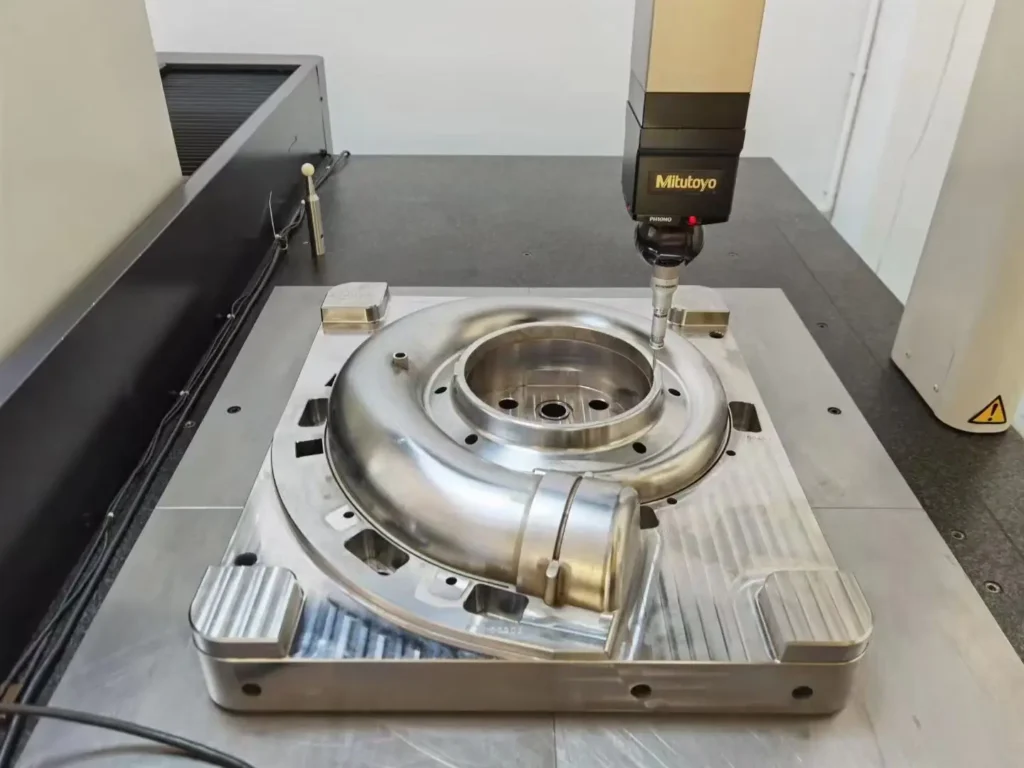
Steel Grades for mold tooling transfer Manufacturing
Tool steel selection directly impacts mold durability, surface finish, dimensional stability, and production efficiency.
| Tool Steel | Application | Hardness |
|---|---|---|
| P20 | General industrial molds | HRC 28–34 |
| 718H | Improved polishability and toughness | HRC 33–38 |
| H13 | High-temperature transfer molding applications | HRC 48–52 |
| S136 | Corrosion-resistant and high-gloss molds | HRC 50–55 |
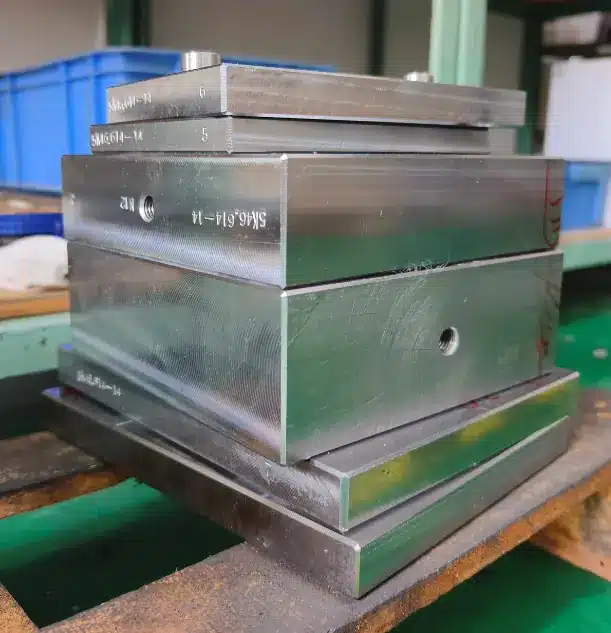
Transfer Molding Tooling Precision & Tolerance Specifications
Our machining and quality control systems are designed to achieve tight dimensional consistency throughout the mold manufacturing process.
| Capability | Specification |
|---|---|
| Machining Accuracy | ±0.005 mm |
| Mold Tolerance | ±0.01 mm |
| Surface Finish | Ra 0.2–0.4 μm |
| Maximum Mold Size | 1200 × 1000 mm |
| Maximum Cavities | 128 |
| Mold Life | 500,000+ Cycles |
±0.005mm precision. Up to 128 cavities.
ISO 9001 & IATF 16949 certified. Made in Dongguan.
Upload your 2D/3D drawing and get a detailed quote with DFM feedback within 24 hours. No hidden fees. NDA available before file transfer.
Transfer Mold Types & Product Range
Three core transfer mold configurations — each engineered for specific material behaviors, part geometries, and production volumes. All manufactured in-house at our Dongguan facility.

Rubber Transfer Mold
Designed for natural and synthetic rubber compounds requiring consistent dimensional accuracy and low flash across high-cavity layouts.
Typical Parts:
O-rings, Seals, Vibration dampers, Grommets

LSR Silicone Transfer Mold
Engineered for liquid silicone rubber with precise temperature control, self-lubricating cavity surfaces, and flash-free parting lines for medical and electronics applications.
Typical Parts:
Medical components, Sealing gaskets, Electronic covers

Insert Transfer Mold
Encapsulates metal, plastic, or electronic components within rubber or silicone — eliminating secondary assembly steps and improving part integrity for demanding applications.
Typical Parts:
Electronic encapsulation,Rubber-bonded metal, Sensor housings
Not sure which mold type fits your part?
Tell us your part requirements — we’ll recommend the right transfer mold configuration for free.
Send us your drawing or describe your part. Our engineering team will review and recommend the optimal mold structure, cavity count, and steel grade — no commitment required.
Industries We Serve with Resin Transfer Mold
From high-volume automotive seals to precision medical silicone components — Senses Mold has delivered transfer mold tooling across five demanding industries worldwide.
Automotive - IATF16949
Transfer molds for high-volume rubber sealing and vibration isolation components used in powertrain, chassis, and body systems. TYPICAL MOLDS FOR Door & window seals, Engine vibration dampers, Suspension bushings, Grommet & wire seals,
EV / New Energy
Precision sealing molds for battery modules, thermal management systems, and high-voltage connector assemblies in electric vehicles. TYPICAL MOLDS FOR Battery cell seals, Coolant system O-rings, HV connector boots, Thermal pad inserts,
Medical - FDA grade
Cleanroom-compatible transfer molds in S136 stainless steel for medical-grade silicone and rubber components requiring biocompatibility. TYPICAL MOLDS FOR Surgical instrument seals, Catheter components, Wearable device parts, Diagnostic equipment seals,
Electronics - RoHS
Insert transfer molds for encapsulating PCBs, sensors, and connectors within rubber or silicone for moisture and vibration protection. TYPICAL MOLDS FOR PCB encapsulation, Sensor housings, Connector boots,
Industrial Sealing
High-cavity transfer molds for standard and custom sealing profiles used in hydraulic, pneumatic, and fluid handling systems. TYPICAL MOLDS FOR O-rings (up to 128 cav), Hydraulic seals, Pump diaphragms, Custom gaskets,
Can’t find your industries above?
Tell us your industry and part requirements — we’ll match you with the right transfer mold configuration and steel grade.
Our engineers have experience across automotive Tier 1, medical OEM, and industrial sealing supply chains. Send your drawing or part specs for a free assessment.
Transfer Mold Process:
From RFQ to Delivery
Every Senses Mold transfer mold goes through a controlled 7-step process — fully in-house, fully documented, with clear milestones and buyer approval at every critical stage.
-
Buyer Approval Gates Design & T1 sign-off
-
CMM Report Included Full dimensional inspection
-
Strict NDA Drawing confidentiality
-
Global Delivery DHL, FedEx or Sea Freight
RFQ & Free DFM Analysis
Upload drawing → engineering team reviews part geometry, material, and cavity count. DFM feedback within 24 hrs.
Mold Design & Approval
Full 3D mold design in CAD. Gate location, runner system, ejector layout — submitted for buyer approval before cutting steel.
Steel Selection & Procurement
Certified steel sourced — P20, H13, S136, 718H, or NAK80 selected based on material, volume, and application requirements.
CNC, EDM & Mirror Finishing
5-axis CNC + Wire EDM + Mirror EDM machining to ±0.005mm. All operations performed in-house under one roof.
Assembly & Mold Fitting
Cavity, core, runner, and ejector system assembled and hand-fitted by senior toolmakers. Parting line and flash gap verified.
T1 Trial & CMM Inspection
First-shot trial with actual material. CMM full dimensional report issued. T1 sample and report sent to buyer for approval.
Packaging & Global Shipping
Mold cleaned, rust-proofed, and custom-packaged with full documentation. Shipped worldwide via DHL, FedEx, or sea freight.
Start your tooling project today
Upload your drawing and we’ll kick off Step 1 — free DFM analysis and quote within 24 hours.
Why Buyers Choose Senses Mold Over Other Suppliers
The difference isn’t just in what we say — it’s in what we can prove. Here’s how Senses Mold compares to a typical transfer mold supplier.。
| Capability | Senses Mold | Typical Supplier |
|---|---|---|
| Machining tolerance | ±0.005mm (Wire EDM verified) | ±0.02–0.05mm |
| Max cavity count | Up to 128 cavities | 16–32 typical |
| Manufacturing | ✓ 100% in-house | ✗ Often subcontracted |
| CMM inspection report | ✓ Included with every mold | Extra charge or not offered |
| Quality certification | ISO 9001 + IATF 16949 | ISO 9001 only |
| Free DFM analysis | ✓ Included before quoting | Rarely offered |
| Mold warranty | 1 year + lifetime support | 3–6 months typical |
| Buyer approval gates | ✓ Design + T1 sign-off | ✗ Not standard practice |



Ready to verify for yourself?
Send us your drawing — get a free DFM report and quote within 24 hours. No commitment required.
Frequently Asked Questions About Transfer Molds
Transfer molds use a transfer pot and runner system to force material into mold cavities, providing better dimensional consistency and improved molding of complex geometries. Compression molds place material directly into the cavity and are generally more suitable for simpler parts and lower tooling costs.
Transfer mold tooling costs vary depending on cavity count, part complexity, mold size, steel grade, and production volume requirements. Simple prototype molds typically cost less than high-cavity production molds. Contact our engineering team for a customized quotation.
Most custom transfer molds can be manufactured within 3–6 weeks, depending on design complexity, material requirements, and cavity configuration. Prototype tooling may be completed faster for urgent projects.
A properly designed and maintained transfer mold can typically achieve 500,000 to over 1 million molding cycles. Mold life depends on tooling steel selection, molding material, operating conditions, and maintenance practices.
Yes. We manufacture custom insert transfer molds for applications requiring metal inserts, electrical terminals, threaded components, and reinforced assemblies. Insert molding helps improve part functionality and assembly efficiency.
Transfer molding is compatible with a wide range of materials, including EPDM, NBR, FKM, silicone rubber, natural rubber, phenolic compounds, epoxy compounds, and other thermoset materials. Material selection depends on the application's temperature, chemical resistance, and mechanical performance requirements.
Multi-cavity transfer molds increase production output, improve manufacturing efficiency, reduce unit cost, and ensure consistent part quality across large production runs. They are ideal for medium- to high-volume manufacturing programs.
The best steel depends on production volume and application requirements. P20 is commonly used for general applications, H13 offers excellent heat resistance, while S136 provides superior corrosion resistance and surface finish performance. Our engineers recommend the most suitable steel based on your project needs.
High-precision transfer mold tooling can achieve tolerances as tight as ±0.01 mm, depending on part geometry, material characteristics, and molding conditions. Critical dimensions are verified through strict quality control procedures.
Comprehensive Transfer Mold Knowledge Hub
Explore Expert Resources on Transfer Mold Design, Cost, Materials, and Manufacturing
Whether you are comparing molding technologies, evaluating tooling costs, selecting mold steels, or sourcing transfer molds from China, our engineering resources help you make informed decisions and reduce project risks.
Comparison & Selection
- Transfer Mold vs Compression Mold vs Injection Mold → Read More
- Transfer Mold Tooling Cost: China vs USA vs Europe → Read More
- Rubber Transfer Mold vs Silicone Transfer Mold: Key Differences → Read More
- Single Cavity vs Multi-Cavity Transfer Mold: Which is Right for You? → Read More
- Transfer Molding vs Liquid Injection Molding (LIM): A Technical Comparison→ Read More
Transfer Mold Design
- Transfer Mold Design Guide: DFM, Gate, Draft Angle & Venting → Read More
- Transfer Mold Steel Grades: P20 vs H13 vs S136 vs NAK80 Selection Guide → Read More
- How to Design a Multi-Cavity Transfer Mold: Runner Balance & Cavity Layout → Read More
- Transfer Mold Surface Finish: Ra Values, Mirror EDM & Polishing Standards → Read More
- Insert Transfer Mold Design: Encapsulating Metal & Electronic Components→ Read More
Transfer Mold Supplier
- How to Source Transfer Mold Tooling from China: A Step-by-Step Guide → Read More
- What Certifications Should a Transfer Mold Supplier Have? → Read More
- Transfer Mold Tooling Lead Time: What Affects It and How to Reduce It → Read More
- Transfer Mold Tooling Cost Guide: What Affects the Price?→ Read More
- Transfer Mold Quality Control: T1 Trial, CMM Inspection & Acceptance Criteria→ Read More
Get Your Custom Compression Mold Quote in 24 Hours
Tell us your requirements — material, quantity, tolerance, and application — and our compression mold engineers will respond with a detailed quote and DFM feedback within one business day.
Have a drawing?
Send your DXF, STEP, IGES, or PDF — get a quote and free DFM review within 24 hours.
Describe your need
No drawing yet? Tell us your material, size, and application — we’ll guide you through the options.
Research stage?
Contact our Compression Mold Design team— free, no sign-up required.
